A call bot is no longer a futuristic idea. It is a practical, proven tool that businesses of all sizes are using right now to answer calls, solve simple problems, and route customers to the right place faster than ever. As more companies explore AI for growing businesses (IPS News), organizations are starting to discover how virtual agents help deliver faster and smarter customer support.
For companies aiming to streamline communication, affordable cloud computing solutions for business teams make it easier to integrate call bots at scale. Many organizations are also adopting supercomputing power for AI customer service applications to process high volumes of customer requests in real time. Marketing professionals can leverage effective strategies for engaging customers online with AI tools to ensure every interaction is personalized and efficient.
Businesses looking to implement AI-driven tools can benefit from practical marketing guides for growing customer engagement, helping call bots support campaigns and customer follow-ups. And for smarter financial planning around technology investments, trusted financial resources for budgeting business software solutions provide guidance to maximize the value of your call bot initiatives. When designed well, a call bot boosts satisfaction, reduces costs, and frees your team to focus on higher-value conversations.
This guide walks you through what a call bot is, how it works, the benefits you can expect, and how to get started in a smart, low‑risk way.
Top 10 AI Call Bot and Contact Center Solutions
Artificial intelligence is transforming the way businesses manage customer interactions. Implementing an AI call bot can streamline processes, reduce wait times, and improve customer satisfaction. Here’s a look at the top AI contact center solutions available today.
1. Bright Pattern – AI Contact Center Solution
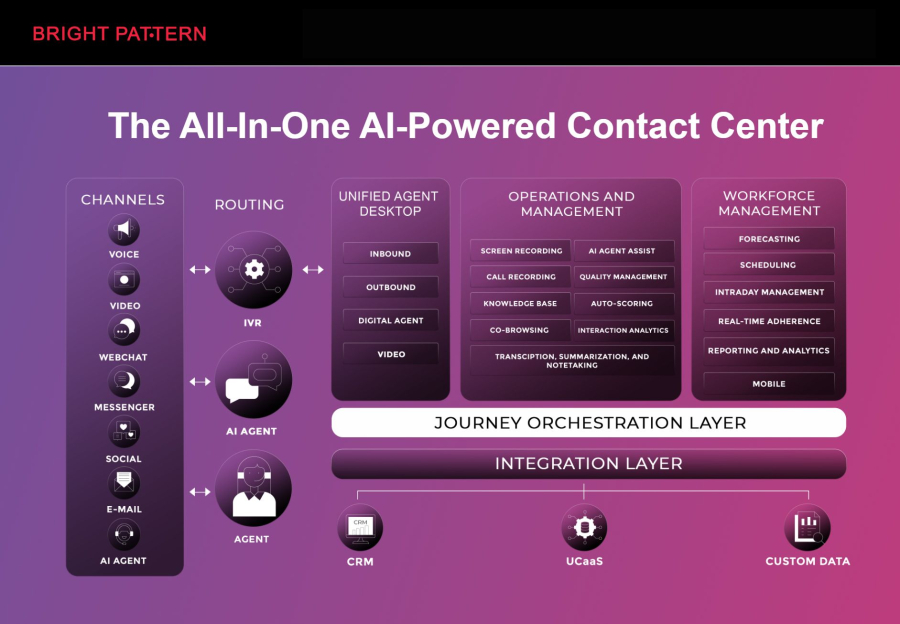
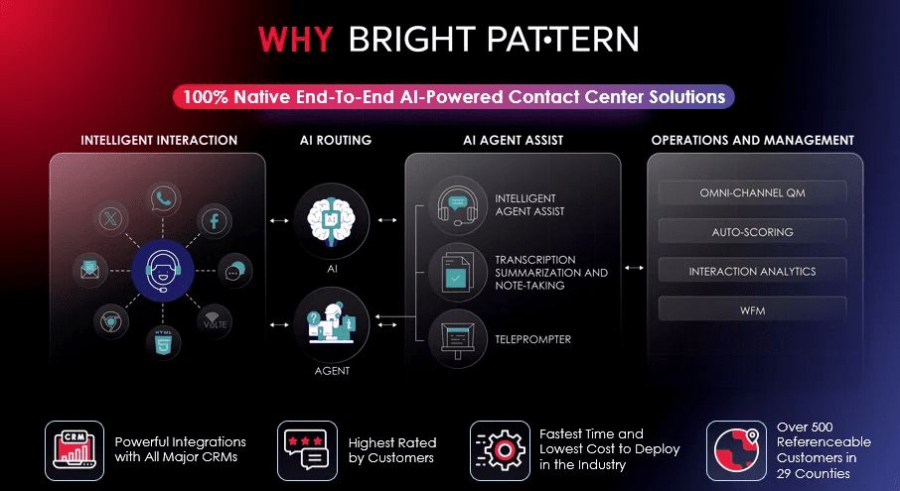
Bright Pattern is a leading AI contact center solution that helps businesses deliver seamless customer experiences across multiple channels. Its advanced AI call bot capabilities make it easy to automate routine inquiries and provide personalized support. Key features include:
- Omnichannel support across voice, chat, email, and social media
- Intelligent call routing to the right agent or department
- AI call bot automation for common customer requests
- Real-time analytics and reporting to track performance
- Integration with CRM systems for personalized service
Bright Pattern is designed for businesses of all sizes, making it a flexible solution for companies looking to implement AI-driven customer support efficiently.
2. Five9 Cloud Contact Center
Five9 provides a cloud-based contact center platform with AI call bot integration to handle inbound and outbound customer interactions. Its predictive dialers and virtual agents improve call efficiency and customer satisfaction.
3. Genesys AI Customer Experience
Genesys offers a comprehensive AI-driven contact center platform that automates repetitive tasks and enhances agent productivity. AI call bots assist with call routing, FAQs, and lead qualification.
4. Avaya OneCloud CCaaS
Avaya OneCloud delivers a scalable contact center solution with AI-powered virtual agents that streamline customer support and provide actionable insights for better decision-making.
5. Talkdesk CX Cloud
Talkdesk CX Cloud integrates AI call bots to automate routine interactions and provide personalized support across channels, helping reduce agent workload and improve response times.
6. NICE inContact CXone
NICE inContact CXone leverages AI to deliver smart routing, virtual assistants, and predictive analytics, allowing businesses to enhance their customer engagement strategies.
7. Cisco Webex Contact Center
Cisco Webex offers a cloud-based contact center solution with AI-powered virtual agents to assist with call handling, self-service automation, and analytics-driven performance improvements.
8. 8x8 Contact Center
8x8 provides a unified platform with AI call bots for automating customer support, managing high call volumes, and delivering insights for better operational efficiency.
9. RingCentral Contact Center
RingCentral Contact Center integrates AI and automation to improve response times, manage multi-channel communications, and enhance customer experiences.
10. Zendesk AI Support
Zendesk AI Support combines AI call bots with a robust ticketing system, enabling automated responses and improved agent productivity while keeping customer satisfaction high
What Is a Call Bot?
Acall botis an automated system that answers phone calls and interacts with callers using natural language. Instead of pressing numbers on a keypad, customers can simply speak in their own words, and the call bot understands, responds, and takes action.
In practice, a call bot can:
- Greet callers and understand why they are calling.
- Provide information such as opening hours, order status, or account balances.
- Perform simple actions like resetting a password or updating contact details.
- Route complex issues to the best available human agent with context.
Modern call bots are often powered byspeech recognitionandnatural language understanding, allowing them to handle more natural, free‑form conversations than traditional menu‑based IVR systems.
Why Businesses Are Turning to Call Bots
Businesses adopt call bots for one straightforward reason: they make the phone channel faster, more efficient, and more satisfying for both customers and employees.
Here are the standout benefits.
1. 24/7 Availability Without Burning Out Your Team
A call bot never sleeps. It can answer calls outside business hours, on weekends, and during seasonal peaks.
- Customers get support when it is convenient for them, not only during office hours.
- Fewer voicemails and abandoned calls mean more captured opportunities.
- Critical tasks like card blocking, appointment cancellation, or outage updates are available around the clock.
2. Faster Answers and Shorter Wait Times
Customers tend to dislike waiting on hold. A call bot can respond immediately, handle many requests in parallel, and resolve simple questions in seconds.
- Immediate greeting and triage reduce perceived wait time.
- Self‑service options let callers help themselves for routine tasks.
- When a human agent is needed, the bot collects information first, so the agent can solve the issue faster.
3. Lower Cost per Call
Every live call has a cost, especially when volumes are high. Call bots help you handle more calls without linearly increasing your headcount.
- Automate repetitive, low‑value calls like balance inquiries or order tracking.
- Free up agents to focus on complex, higher value conversations.
- Scale up for peak periods (for example, holidays or campaigns) without large temporary hiring.
4. Consistent, High‑Quality Experiences
Human performance can vary with mood, workload, or experience level. A well‑designed call bot delivers the same high‑quality experience every time.
- Consistent answers aligned with your latest policies and offers.
- No missed mandatory questions or disclosures.
- Standardized workflows help with compliance and quality assurance.
5. Happier, More Productive Agents
Call center work can be demanding. Offloading repetitive questions to a call bot improves the workday for your team.
- Agents spend more time on interesting, value‑adding conversations.
- Lower stress from constant queues of simple, repetitive calls.
- Better use of your team’s expertise for sales, retention, or complex support.
6. Better Data and Smarter Decisions
Because call bots handle conversations in a structured, digital way, they naturally generate rich data.
- See why people are calling in real time.
- Identify common issues to improve products or processes.
- Track key performance metrics like containment, handle time, and satisfaction.
How a Call Bot Works: The Building Blocks
From the caller’s perspective, a call bot feels like a simple conversation over the phone. Behind the scenes, several technologies work together.
1. Telephony and Call Routing
The call first reaches your phone system. From there, calls can be routed to the call bot, to human agents, or a mix of both depending on your call flows and business rules.
2. Speech Recognition
When the caller speaks,automatic speech recognition(ASR) technology converts the audio into text. This enables the bot to process what was said.
Modern ASR can handle a range of accents and speaking styles. The quality of speech recognition has a major impact on how natural and accurate the call bot feels.
3. Natural Language Understanding (NLU)
The text is then passed to anNLU enginethat interprets the intent behind the caller’s words. For example, the NLU might classify a sentence as:
- “Check order status”→ track an order.
- “I lost my card”→ block or replace a card.
- “Reschedule my appointment”→ modify an existing booking.
The NLU may also extract important details like dates, times, product names, or numbers.
4. Dialogue Management
Thedialogue managerdecides how the bot responds based on the caller’s intent, previous turns in the conversation, and your business rules.
- If enough information is available, it can complete the task immediately.
- If something is missing, it asks a follow‑up question.
- If the issue is too complex or risky to automate, it transfers the caller to a human agent.
5. Integrations with Your Back‑End Systems
To be truly useful, a call bot connects to your existing systems. Typical integrations include:
- Customer relationship management for identities and history.
- Order management for tracking and changes.
- Booking systems for appointments and reservations.
- Billing or payment systems for balances and payments.
These integrations turn the call bot from a simple information source into a full self‑service channel.
6. Text‑to‑Speech (TTS)
Finally, the bot’s response is converted from text back into spoken words usingtext‑to‑speech. TTS voices have improved significantly, sounding more natural and easier to understand than early generations.
7. Analytics and Continuous Improvement
Every interaction provides data. Over time, you can use it to refine your call flows, add new self‑service options, and improve recognition and responses.
Common Use Cases for Call Bots
Call bots can support many scenarios across industries. Here are popular use cases where businesses see quick wins.
Customer Service and Support
- Order status and delivery updates.
- Basic account information and balance inquiries.
- FAQ answers such as opening hours, locations, and return policies.
- Service outage information and status updates.
Appointments and Reservations
- Booking, rescheduling, or cancelling appointments.
- Sending reminders or confirmations via the channels you use.
- Managing waitlists and callbacks.
Billing and Payments
- Checking outstanding balances or due dates.
- Confirming recent transactions.
- Taking secure payments through automated flows where appropriate.
Order Management
- Tracking orders and shipments.
- Checking product availability.
- Capturing simple order changes within defined rules.
Internal Helpdesk and IT Support
- Password resets and account unlocks.
- Basic troubleshooting steps for common issues.
- Status updates on internal incidents or maintenance.
Call Bot vs. IVR vs. Chatbot
It is useful to distinguish between a modern call bot, a traditional IVR, and a text‑based chatbot.
Technology | Channel | Interaction Style | Typical Experience |
Call bot | Phone (voice) | Natural language, spoken | Conversational, understands free‑form speech, automates tasks and routing. |
IVR (Interactive Voice Response) | Phone (voice, keypad) | Menus, keypad presses, limited phrases | Menu‑based navigation, less flexible and often slower for complex needs. |
Chatbot | Web, app, messaging | Typed messages | Text chat, good for multitasking and environments where speaking is not ideal. |
A call bot brings the conversational flexibility of a chatbot into the phone channel, where many customers still prefer to seek help or speak to a brand.
Is a Call Bot Right for Your Business?
Most organizations that handle regular phone traffic can benefit from call automation. You are likely to see strong value from a call bot if:
- You receive a high volume of calls with repeating questions.
- Your team spends significant time on simple, transactional calls.
- Customers often struggle with long hold times or call drops.
- You operate outside a single time zone or serve customers across regions.
- You want better visibility into why people call and how calls are handled.
Industries that often see quick wins include retail, e‑commerce, banking, insurance, healthcare, utilities, logistics, travel, and hospitality. Yet even smaller businesses can benefit from a focused call bot that handles just a few high‑volume tasks.
Key Steps to Launch a Successful Call Bot
Launching a call bot does not have to be a huge project. A structured approach helps you get results quickly while managing risk.
1. Define Clear Goals and Use Cases
Start by clarifying what success looks like. Common goals include:
- Reducing average wait time by a specific margin.
- Automating a portion of high‑volume call types.
- Improving customer satisfaction with the phone channel.
- Extending service hours without adding headcount.
Then, list your top call reasons and select two or three that are:
- High volume.
- Structured and repetitive.
- Low risk and easy to automate.
2. Map the Ideal Caller Journey
Before you touch technology, sketch out the ideal conversation for each chosen use case.
- What should the greeting say?
- What information does the caller need to provide?
- What actions should the bot take in response?
- At which points should the caller have the option to speak to a human?
This customer‑first approach keeps the experience simple and natural.
3. Choose the Right Technology Partner or Platform
When evaluating call bot solutions, look for:
- Reliable speech recognition that matches your language and accents.
- Strong NLU capabilities with proven results in your industry if possible.
- Easy integrations with your CRM, helpdesk, and core systems.
- Tools to design conversation flows without heavy coding.
- Robust analytics and monitoring capabilities.
4. Design Conversations with Empathy
Successful call bots feel clear, polite, and helpful. Focus on:
- Short, simple prompts that are easy to understand by phone.
- Natural language that reflects how your customers actually speak.
- Clear confirmation of important information like dates, amounts, or addresses.
- Easy ways to correct mistakes or repeat information.
5. Integrate with Your Systems and Test Thoroughly
Connect the call bot to the systems it needs and then test with:
- Realistic sample data and edge cases.
- Different accents and speaking speeds.
- Background noise scenarios where possible.
Invite front‑line agents to test early. Their daily experience with callers helps uncover gaps and opportunities.
6. Train and Involve Your Team
A call bot works best when your human team understands and supports it.
- Explain what the bot will do and how it helps agents.
- Show how calls will be transferred and what context agents will see.
- Encourage feedback from agents to continuously improve the bot.
7. Launch Gradually and Optimize
Instead of switching everything on at once, you can:
- Start with a subset of callers or a limited set of use cases.
- Monitor key metrics and call recordings for quality.
- Iterate quickly on prompts, flows, and handoff rules.
This staged approach helps you build a strong, reliable experience while steadily adding capabilities.
Best Practices for a Call Bot Customers Will Love
The difference between a frustrating robot and a delightful assistant comes down to thoughtful design. These practices keep customers at the center.
Make It Easy to Reach a Human
One of the fastest ways to build trust is to provide clear paths to a live agent when needed.
- Offer an option to speak to someone at sensible points in the journey.
- Detect frustration signals such as repeated “agent” requests or silence.
- Pass context so callers do not need to repeat themselves.
Set Expectations from the Start
Let callers know they are speaking with an automated assistant and explain what it can do.
- Greet clearly and concisely.
- Mention a few tasks the bot can help with.
- Reassure callers that a human is available if their issue is complex.
Design for Real‑World Conditions
Real phone calls are messy. Plan for interruptions, background noise, and incomplete answers.
- Confirm key details and allow corrections.
- Offer to repeat or rephrase when recognition is uncertain.
- Use brief prompts and avoid long explanations.
Use Data to Continually Improve
A call bot should get better over time. Review data and feedback to refine it.
- Analyze where callers drop off or ask for agents.
- Identify new intents or tasks you can automate.
- Update scripts and training data as your business changes.
How to Measure Call Bot Success
Clear metrics help you prove value and target improvements. Useful measures include:
- Containment rate: the share of calls fully handled by the bot.
- Average handle time: how long it takes to resolve or route an issue.
- Deflection to self‑service: calls that would otherwise reach agents.
- Customer satisfaction, gathered via short post‑call surveys.
- Agent productivity: more time spent on complex or revenue‑driving tasks.
By tracking these, you can clearly see how the call bot reduces friction for customers and frees resources across your organization.
The Future of Call Bots
Several trends are shaping the next generation of call bots and opening up even more opportunities for business value.
- More natural conversationsthanks to ongoing improvements in speech recognition and language models.
- Deeper personalizationusing customer history, preferences, and context to tailor conversations.
- Omnichannel experienceswhere customers can move smoothly between phone, chat, and other channels without losing context.
- Proactive outreachsuch as appointment reminders, delivery notifications, or renewal prompts through outbound calls when this matches your strategy and regulations.
Conclusion: Turning Your Phone Channel into a Smart Assistant
A well‑implemented call bot transforms your phone line from a cost center into a powerful, always‑on assistant. It answers quickly, handles routine tasks with ease, and guides customers to the right help at the right time.
By starting with clear goals, focusing on high‑value use cases, and designing conversations with empathy, you can deliver a phone experience that feels modern, efficient, and human‑friendly. Your customers enjoy faster, more convenient service, and your team gains the time and space to do their best work on the conversations that truly need a human touch.
